Over the years that followed, the two grew in parallel. The more time I spent in the field — across disability, child rights, education, environment, and rural livelihoods — the more clearly I understood what an image needed to say. Photography came first, and as the stories grew more complex, videography became an equally essential part of the language. A still could hold a moment. A film could hold a journey.
Teaching entered the picture in a similar way — organically, through the field. My first classes were fundraisers for non-profits. Then came workshops with hearing-impaired communities. Gradually, teaching photography became its own professional thread — one that eventually led to a visiting faculty role at AAFT (Asian Academy of Film and Television), Noida, and my current role as visiting faculty at the Delhi School of Photography.
Along the way I learned American Sign Language and was entrusted with the responsibility of trusteeship at GiftAbled Foundation — a recognition I hold with deep respect. More than credentials, though, what the field gave me was an understanding that is harder to articulate but easier to see in the work: where to draw a line, how to be genuinely respectful to beneficiaries and underprivileged communities, how to document organically without imposing a narrative, and how to earn the kind of trust that allows real stories — not performed ones — to emerge. That quality of presence in the field, I believe, is not something you can learn from a camera manual. It comes from years of simply showing up — as a volunteer, a listener, and eventually, a filmmaker.
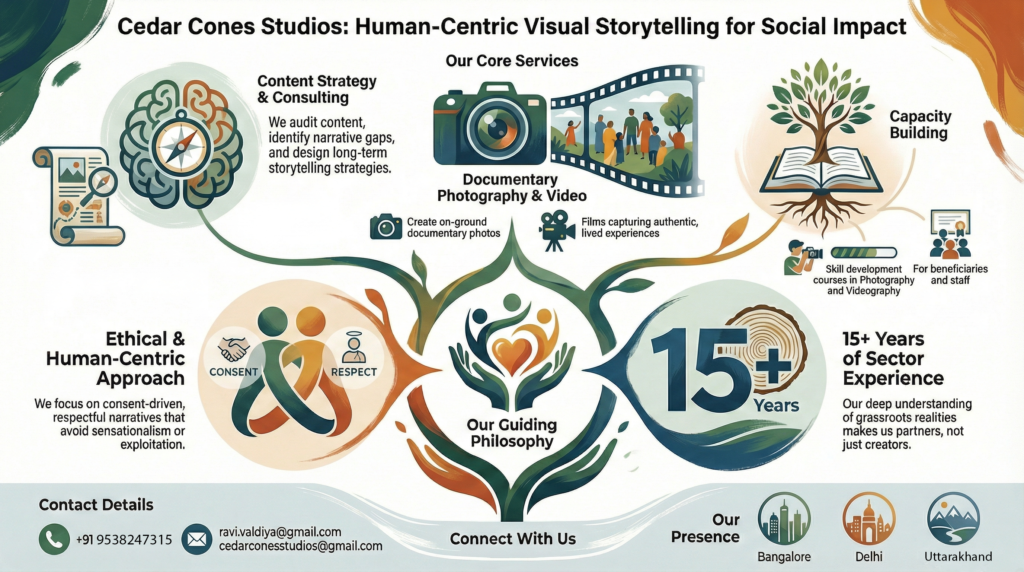
By 2014 I was taking professional photography assignments. In 2019 I came out of corporate life entirely — and within months, Cedar Cones Studios was founded. Not as a pivot. But as the natural shape a decade of parallel learning had taken.
When I walk into a field assignment today, I bring both — the filmmaker’s eye and the field person’s understanding. They are not two separate things I have combined. They grew as one.